From Dashboards to Data Products: A Case for Rebalancing Competitive Intelligence Investment
- Nilotpal Choudhury
- Jul 29
- 4 min read

TL;DR: The competitive advantage in market intelligence is shifting from bespoke dashboards to owned, governed data repositories. By diverting investment toward proprietary data products — combining licensed pricing, supply signals, financial filings, internal win/loss records, and news into an interoperable layer — organizations can let commoditized GenAI interfaces (Claude, Copilot, Gemini) do the delivery work. Custom UX is not waste; it is simply no longer the highest-leverage place to place the next dollar. The call is to rebalance, not abandon, the investment portfolio: keep a thin, workflow-embedded delivery layer, but make the data product the primary asset.
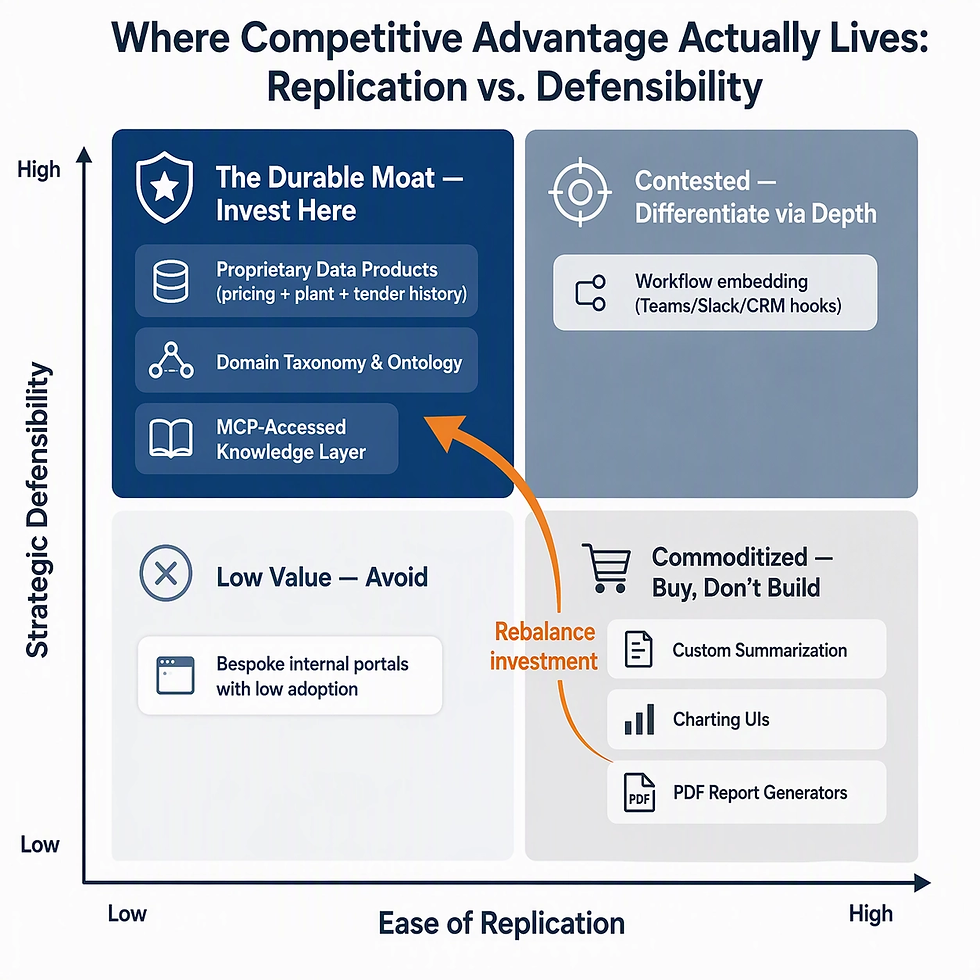
The moat has moved from UI to proprietary content coverage and workflow integration
Market intelligence vendors no longer win on dashboard aesthetics alone. AlphaSense’s ascent to a ~$4B valuation and past $500M ARR was driven by content acquisitions—Sentieo (2022), Tegus (2024 for $930M), and Carousel (2025)—not by a better search bar. Tegus alone brought 200,000+ expert transcripts and Canalyst’s ~4,500 financial models. The durable asset is curated, licensed, hard-to-replicate content.
Gartner’s inaugural 2026 Magic Quadrant for Competitive and Market Intelligence (C&MI) Platforms codifies this shift: Leaders include AlphaSense, Northern Light, Klue, Crayon, and Valona, with Visionaries such as Contify and Market Logic. The quadrant signals the market is moving from passive monitoring to active orchestration of insights, with content coverage and workflow automation treated as co-equal differentiators. That is not a case for stopping UI investment; it is a case for recognizing that UI alone cannot differentiate.
Commodity UX capabilities have become table stakes
Summarization, charting, PDF generation, and semantic search have been absorbed into the surrounding software ecosystem. Google ML Kit offers GenAI summarization APIs, enterprise BI platforms convert queries into charts automatically, and document generation is available as a near-free primitive. The industry maxim is hard to ignore: “AI wrappers don’t have moats because anyone can call the same APIs you’re using.”
The build-vs-buy arithmetic reinforces the point. A production-grade embedded-analytics module costs roughly $150K–$400K in year one and ~$1M over three years once opportunity cost is included. Buying is typically 4–8 weeks versus 6–12 months to build. Internal teams that continue to hand-craft these capabilities are competing against their own engineering budget rather than against the market. Engineering effort spent building custom web portals or bespoke prompt wrappers often duplicates commercial off-the-shelf (COTS) functionality, with a higher total cost of ownership (TCO) and slower iteration velocity.
Open protocols are decoupling data from the interface
The Model Context Protocol (MCP), released by Anthropic in November 2024 and adopted by OpenAI, Google, and Microsoft, has become the “USB-C for AI.” By December 2025, it supported over 10,000 active public MCP servers and 97M+ monthly SDK downloads. For enterprise intelligence, this changes the integration geometry from N×M — every frontend needs a custom adapter to every backend — to N+M: build the MCP server once, consume anywhere.

Practically, this means a governed data product can be queried from Claude Desktop, Microsoft Copilot, or any internal GenAI wrapper without building a separate web portal for each. The data layer becomes the stable asset; the user interface becomes a replaceable consumption channel.
Competitive intelligence in technical sectors needs connected data, not recycled news
In lubricants and energy, relying on paid news feeds is a fragile strategy because competitors can buy the same feeds. The real edge comes from connecting sources that no one else can replicate in the same way: licensed pricing benchmarks (Argus, ICIS), plant capacity and turnaround schedules, OEM approval mappings, product-grade crosswalks, and internal tender win/loss histories.
Tender and sales teams do not need another generic news digest. They need answers to precise questions: how a synthetic heavy-duty engine oil positions against a specific competitor product in a target market, what plant proximity implies for logistics cost, or whether a price-to-win bid is credible given recent base-oil spreads. Answering these questions requires a hybrid retrieval architecture—structured databases for exact facts, vector repositories for qualitative battlecards, and a unified semantic layer that links them.
The lubricants/energy domain has rich, ownable data layers — but premium pricing is already sold by incumbents (Argus Base Oils weekly spot prices, ICIS Group I/II/III forecasts, Kline & Company plant/capacity data). The durable owned asset is the integration layer — linking licensed pricing + scraped public-web signals + partner plant/supply-center data + internal tender/win-loss history — not re-deriving base-oil prices.
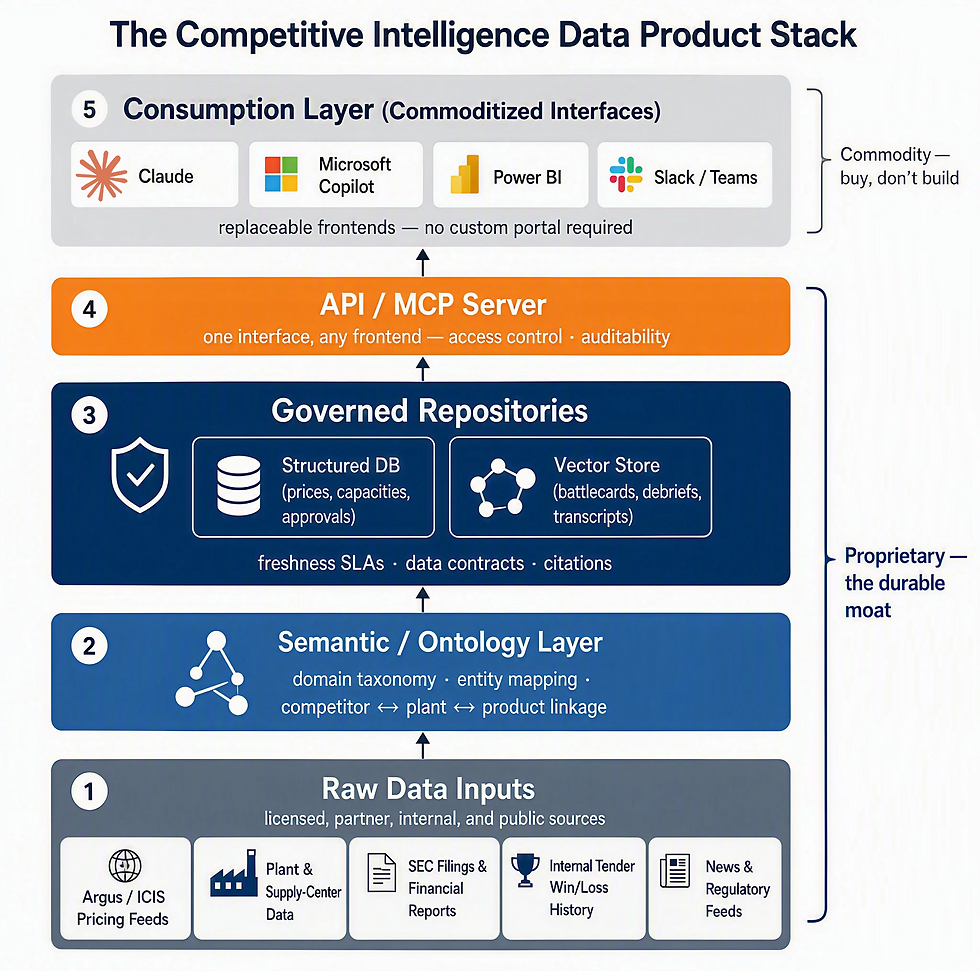
Governance and data quality are now the real differentiators
A retrieval-augmented generation (RAG) system can reduce hallucinations by 70–90%, but only when the underlying knowledge base is curated, fresh, and consistent. Without freshness SLAs, citation-grounding, and a judge model that refuses uncited claims, the same system can confidently repeat stale or contradictory data. One 2026 survey found that 58% of organizations update vector indexes monthly or less — far too slow for high-stakes commercial decisions.
This is where the data product operating model earns its keep. Domain taxonomies, data contracts, source-of-truth policies, and human-in-the-loop exception queues become the machinery that makes GenAI outputs trustworthy.
The moat is not the chatbot; it is the curated, governed knowledge layer behind it.

The practical recommendation: rebalance, not retire
The argument is not that custom UX is worthless. A thin delivery layer—Slack or Teams notifications, browser extensions, standardized Power BI templates—still matters for adoption. The strongest counter-argument to a pure data-layer strategy is the “last mile”: data initiatives fail more often on people and process than on technology. The answer is to embed intelligence into existing workflows rather than build new portals.
Senior leaders should therefore consider three moves in the near term:
Audit the current portfolio. Run a “recycled vs. generated” benchmark against real tender and positioning questions to see how much insight is merely repackaged paid content versus genuinely synthesized from connected data.
Pilot one governed data product. Pick a narrow domain—such as competitor plant and supply-center coverage for one region—and expose it via an MCP endpoint into an existing GenAI frontend. Measure accuracy, citation adherence, and retrieval hit-rate against SME ground truth.
Buy to replace one commodity feature. Test whether off-the-shelf summarization, charting, or PDF generation can match internal quality at lower cost. If parity is achieved, formally redeploy those engineers to data product work.
Custom UX development is not waste. But in the current market, the highest-leverage investment is the proprietary data product: the owned, governed, domain-specific repository that every commoditized interface will want to consume.


Comments